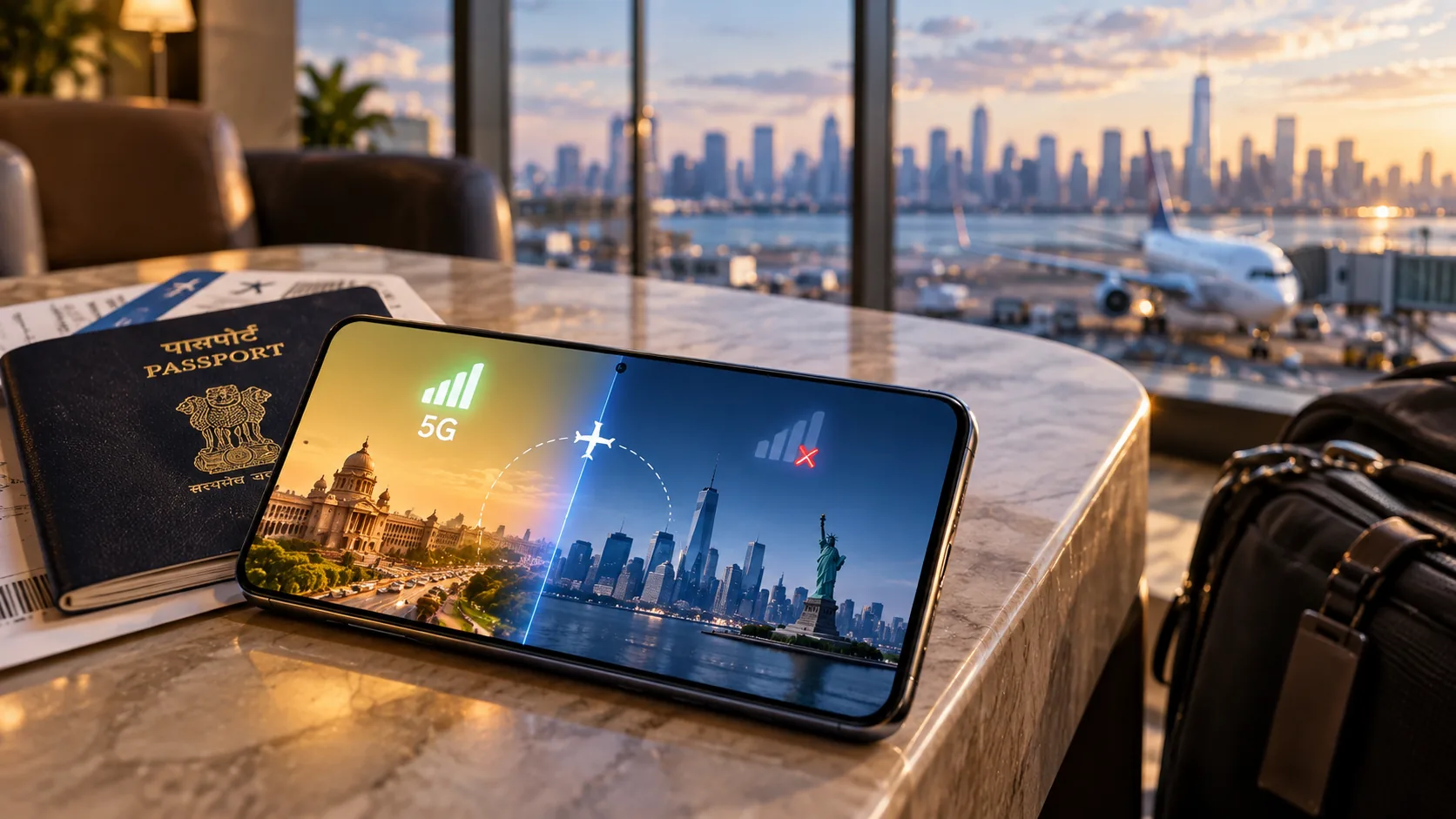
I thought I had checked every spec before buying my phone. I was wrong about one, and it was the one that mattered.
I was standing in America, staring at my phone, waiting for an OTP.
It never came.
My bank needed it. A payment needed it. A login needed it. My phone had a powerful processor, 12 GB RAM, 512 GB storage, excellent cameras and 5G. What it didn’t have, at most places I went, was signal.
And the strangest part? Someone had warned me.
The Warning I Ignored
Before I left for the United States, a trip where I carried my Rotary club flag to meet Rotary clubs in New Jersey and North Carolina, a friend said casually, “Your Chinese phone may not work properly in America.”
I was carrying a fairly new Xiaomi 14 Civi. I heard him, smiled, and ignored him.
Why wouldn’t I? I had been using Xiaomi since the Mi 3, the company’s first smartphone launched in India. Over the years, Xiaomi had earned my trust. It was often called the “Apple of China”, and China builds a large share of the world’s electronics, including iPhones.
On the flight, I mentioned the warning to a co-traveller. He laughed. His wife had been using an old Redmi phone in the US without any trouble.
That settled it. If an old Redmi worked in America, my much newer Xiaomi surely would.
What could possibly go wrong?
What Actually Happened in the USA
I had activated international roaming on my Indian number, including international SMS, so OTPs from my bank and other services could reach me.
On paper, I was ready.
In reality, my phone showed no signal at most places. In a few spots, it worked. Everywhere else, nothing. No calls, no mobile data and, worst of all, no OTPs.
If you are Indian, you know what that means. Almost everything important in our digital lives - banking, UPI, card payments, government services, even email logins - depends on an OTP arriving on your registered mobile number. No OTP, no access.
Finally, out of desperation, I tried something simple. I took my SIM card out of my Xiaomi and put it into someone else’s phone, a Google Pixel 9.
It worked. The signal came back. The OTPs started arriving.
Same SIM. Same roaming plan. Same country. Different phone.
The problem was never my SIM or my operator. It was my phone.
The Spec I Had Never Checked: Network Bands
So I started digging, and I landed on a line in the spec sheet that I had scrolled past for years:
Supported network bands.
Here is the simplest way to understand it.
Think of an FM radio. Every radio station broadcasts on its own frequency. If your radio cannot tune to a particular frequency, you will never hear that station - no matter how expensive or powerful your radio is.
Mobile networks work the same way. Each country, and each mobile operator, broadcasts on its own set of frequencies called bands. Your phone can only connect to the bands it was built to support.
My Xiaomi 14 Civi was built mainly for India. It supports the bands Indian networks use. American networks rely heavily on some bands that my phone simply could not “tune in” to.
The Pixel 9, on the other hand, supports a much wider range of bands, so the same SIM found a network almost everywhere.
Isn’t 5G Just 5G?
That was my assumption too. My phone had 5G. America has 5G. Problem solved, right?
No.
“5G” on the box tells you what generation of technology the phone uses. It does not tell you which networks it can actually connect to.
Two phones can both say “5G” and still work very differently once you leave the country.
It Was Never About “Chinese Phones”
Here is the twist. My friend’s warning was not quite right, and neither was my co-traveller’s reassurance.
When I compared my phone with other Xiaomi models, I found that some of them support a much broader range of network bands. Same brand. Both modern. Both 5G. Very different results abroad.
That also explained my co-traveller’s story. His wife’s old Redmi worked in the US because that particular model supported the right bands. The brand did not matter. The exact model did.
This happens across the whole smartphone industry, not just with Chinese brands. Manufacturers build different models, and often different versions of the same model, for different markets. Supporting more bands costs more in hardware, testing and certification, so a phone designed mainly for one country may skip bands needed elsewhere.
My Xiaomi 14 Civi is still an excellent phone. In India, I have no complaints.
It just wasn’t built for where I took it.
Will Your Phone Work Abroad? A 5-Minute Check
You don’t need to become a telecom engineer. Before you buy your next phone, or before your next international trip, do this:
- Find your exact model. Go to Settings → About phone and note the model name and number. The Indian version of a phone can differ from the global version.
- Search for its compatibility. Search for “[your phone model] works in [country]” or use a free phone compatibility checker website. Pick the country and mobile operator you plan to use, and it will tell you whether your phone is a good match.
- Check with your mobile operator. Ask your Indian operator, or the travel SIM provider, whether your specific phone works on their partner networks abroad.
- Plan a backup for OTPs. This one matters most for Indians. Before travelling, set up alternatives wherever possible: email OTPs, authenticator apps, or a second registered number. Don’t let one SMS decide whether you can pay for dinner.
- Carry a backup option. A spare phone that works in that country, or an eSIM-capable phone, can save your trip. My SIM was saved by a Pixel 9 belonging to someone else. Yours might not be.
Xiaomi, Did You Really Let Me Down?
When I stood there without a signal, waiting for an OTP that never came, that is exactly how I felt.
Xiaomi, you let me down.
But once I understood what had happened, I realised Xiaomi was not really the one who let me down.
My buying checklist did.
After more than two decades in technology, I have learned that the costliest problems rarely come from the specs we compare. They come from the questions nobody thought to ask. That is true when a company picks its software, and it turned out to be true when I picked my phone.
So the next time I buy a phone, I will still compare RAM, processor and cameras.
But I will add one more question:
Where in the world will this phone actually work?
My friend tried to warn me. I ignored him.
I won’t scroll past that line in the spec sheet again. I hope you won’t either.
Frequently Asked Questions
Why is my Indian phone not working in the USA?
Most often, your phone does not support the network bands that US operators use. Phones made mainly for the Indian market support Indian bands, and some miss bands that are important in the US. Your SIM and roaming plan may be fine; the phone simply cannot connect.
Why am I not receiving OTPs while travelling abroad?
OTPs arrive by SMS, and SMS needs a working mobile network connection. If your phone cannot connect to the local network, OTPs will not arrive even if you have activated international roaming and SMS. Trying your SIM in a different, compatible phone is a quick way to confirm whether the phone is the problem.
Do Chinese phones work in the USA?
Some do and some don’t. It depends on the exact model, not the brand or country of manufacture. Even within one brand, different models support different network bands.
How can I check if my phone will work in another country?
Find your exact model number in your phone’s settings, then search for its compatibility with the country and operator you plan to use, or use a free phone compatibility checker website. You can also ask your mobile operator before you travel.
Does a 5G phone work everywhere in the world?
No. “5G” only describes the technology generation. Whether your phone connects abroad depends on whether it supports the specific bands used by operators in that country.