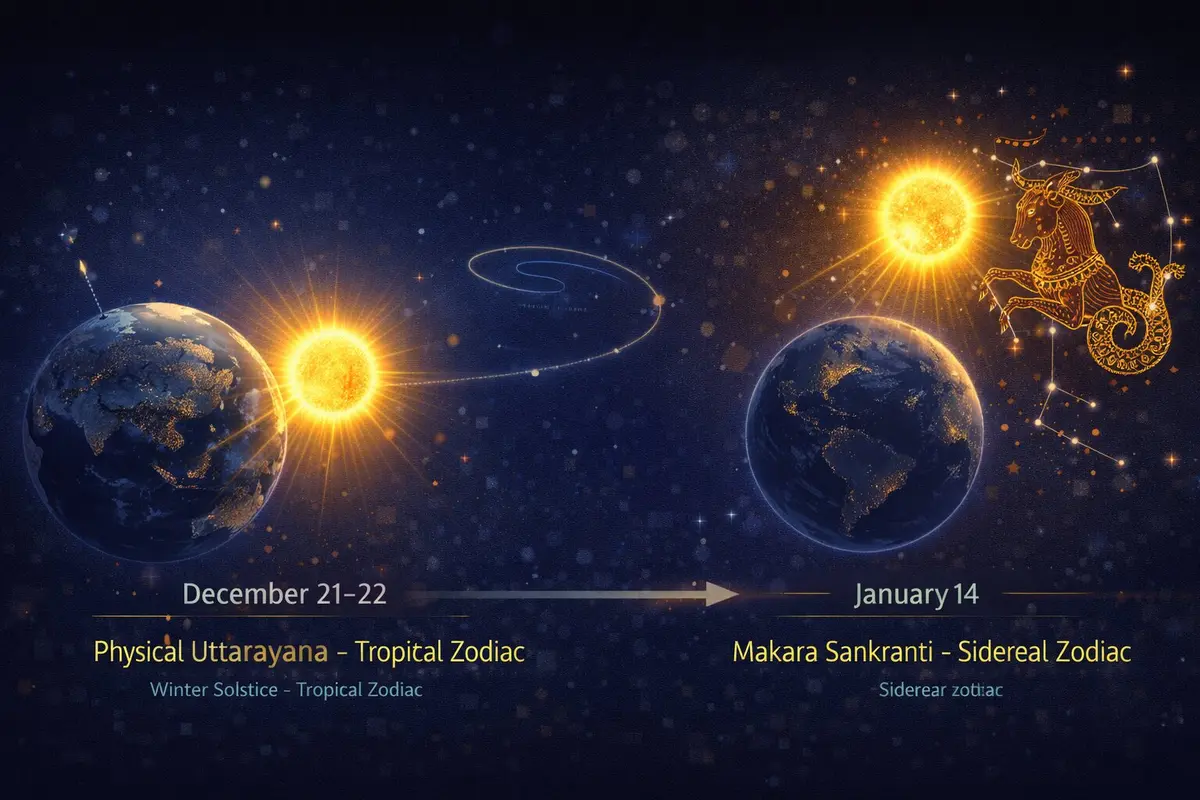
Every year on January 14, millions across India celebrate Makara Sankranti as the day the Sun begins its northward journey—Uttarayana.
But there’s a problem.
By that date, the Sun has already been moving north for nearly three weeks.
The Winter Solstice—the actual astronomical turning point—happens around December 21.
So which is it? When does Uttarayana really begin?
The question kept haunting my mind. The more I thought about it, the more the gap bothered me.
So I did what most of us do when something doesn’t quite add up. I started digging.
What I discovered was not a contradiction, but a fascinating insight into how astronomy, calendars, and tradition intersect.
The answer lies in the fact that we are unknowingly mixing two different reference systems.
The Astronomical (Physical) Reality
From a purely physical and observational standpoint:
- On the Winter Solstice (21–22 December), the Sun reaches its southernmost point in the sky
- This day has the shortest daylight in the Northern Hemisphere
- From the very next day, the Sun’s declination starts shifting northward
- Daylight begins to increase, slowly but steadily
This is not symbolic or cultural. It is driven entirely by Earth’s axial tilt and orbital motion.
In strict astronomical terms, this is the true start of the Sun’s northward journey.
Winter Solstice vs Makara Sankranti: The 23-Day Gap
Makara Sankranti (usually 14 January) is often described as the start of Uttarayana. But technically, that’s not what it marks.
Makara Sankranti is the moment when the Sun enters the zodiac sign Capricorn (Makara) in the sidereal zodiac—a system that measures celestial positions relative to fixed stars, rather than to seasonal markers like equinoxes and solstices.
In simple terms, this event represents:
- A zodiacal sign transition
- Based on fixed star positions, not seasons
- A calendar and cultural marker, not a physical turning point
By the time Makara Sankranti arrives, the Sun has already been moving northward for nearly three weeks.
Sidereal vs Tropical Zodiac: Understanding the Difference
This is where science quietly explains tradition.
The Earth’s axis undergoes a slow wobble called precession of the equinoxes.
Here’s how it works:
- The zodiac shifts by approximately 1 degree every 72 years
- Over about 1,700 years, this drift accumulates to roughly 23–24 days
- Around 272–291 CE, Makara Sankranti and the Winter Solstice actually coincided
- Since then, the solstice has stayed seasonally fixed, but the sidereal zodiac has continued to drift
Indian calendrical systems followed the sidereal (star-based) zodiac, while modern astronomy adopted the tropical (season-based) framework.
Neither is wrong. They are simply answering different questions.
Precession of Equinoxes: Why Makara Sankranti Keeps Shifting
What surprised me even more is that this precession is not a one-time historical curiosity—it’s ongoing.
Consider this:
- In 1600 CE, Makara Sankranti fell on 9 January
- Today, it falls on 14 January
- By 2600 CE, it will fall on 23 January
- After about 9,000 years, Makara Sankranti will occur in June
The festival will continue to drift further from the winter solstice with each passing century.
So When Does Uttarayana Really Begin?
| Perspective | Start of Uttarayana |
|---|---|
| Modern astronomy (physical reality) | Winter Solstice (21–22 December) |
| Traditional Indian astronomy (sidereal system) | Makara Sankranti (around 14 January) |
The confusion arises only when we expect one system to behave like the other.
The Bottom Line
Makara Sankranti does not mark the physical start of the Sun’s northward movement.
It marks the Sun’s entry into Capricorn (Makara) in the sidereal zodiac—a star-based system that has drifted from seasonal markers over millennia.
The physical start? That’s the Winter Solstice, around December 21–22.
The traditional start? That’s Makara Sankranti, around January 14.
Both are correct. They’re just measuring different things.
Once this distinction is understood, there is no contradiction.
We gain something better instead:
✦ Scientific clarity ✦ Cultural continuity ✦ Respect for both observation and tradition
And that, perhaps, is the real beauty of how ancient knowledge and modern science quietly coexist—not in conflict, but in conversation.
Historical Note: The last alignment of Makara Sankranti with the Winter Solstice occurred around 272–291 CE, approximately 1,700 years ago, based on the Lahiri Ayanamsha calculation used in Indian astronomical traditions.