Thousands of kilometres from India, yet something felt familiar.
Travel has an interesting way of showing us differences.
But sometimes, it does exactly the opposite.
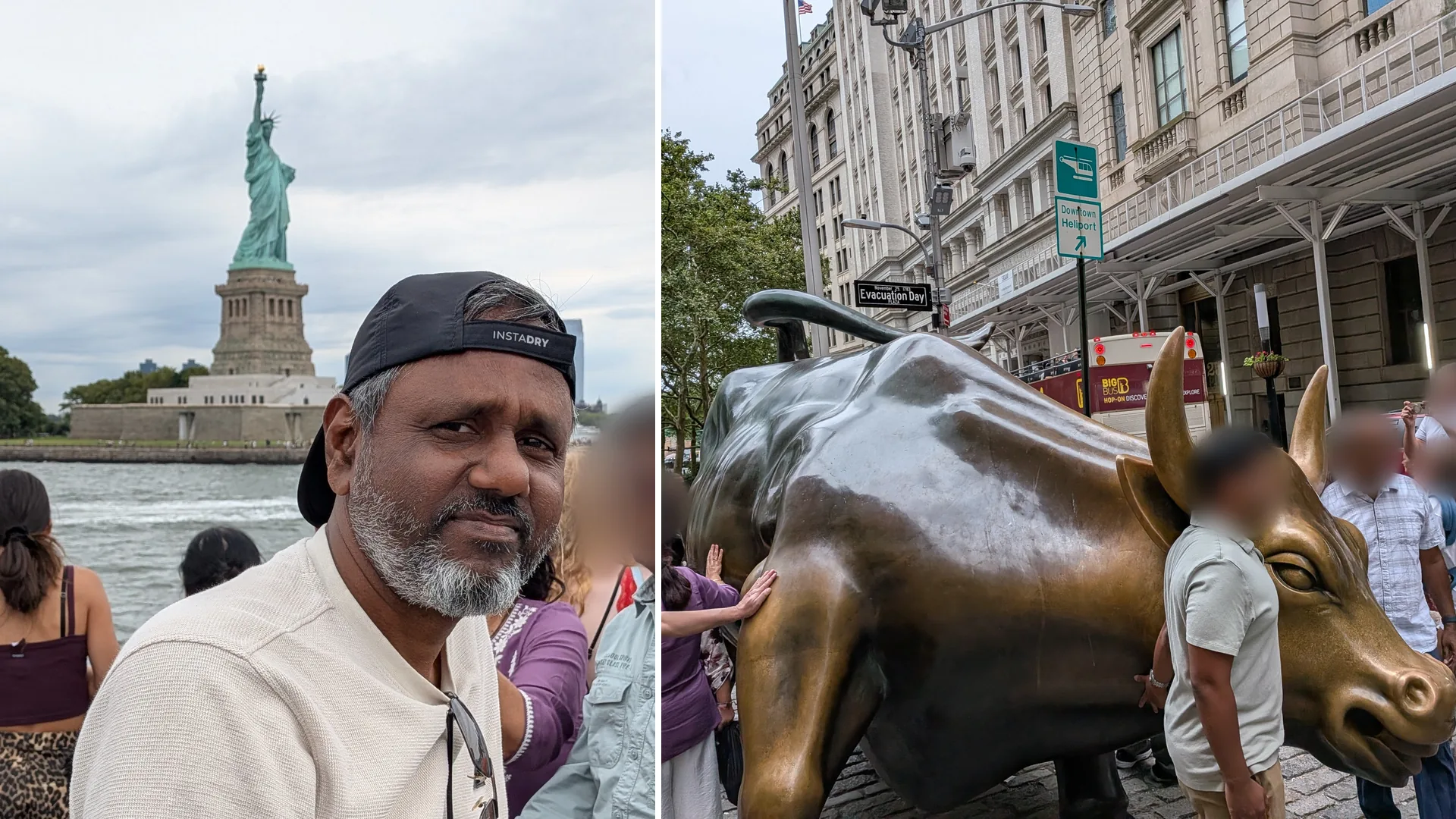
During a recent visit to New York, on the same trip where my phone stopped working the moment I landed, I stood before two of America’s most recognisable symbols: the Statue of Liberty and the Charging Bull of Wall Street.
Both were unmistakably American.
And yet, strangely, both reminded me of India.
Not because of any historical connection. Not because one culture borrowed from another.
It was something simpler.
They felt familiar.
Liberty as a Devi
Standing before the Statue of Liberty, one thing struck me immediately.
Here was a majestic female figure, raised high above the crowd, holding symbols in her hands and representing something much larger than herself.
Liberty.
The statue is modelled on Libertas, the Roman goddess of liberty.
And suddenly, as an Indian, the idea didn’t seem foreign at all.
In India, we have lived with this vocabulary for centuries.
Knowledge takes the form of Saraswati.
Prosperity takes the form of Lakshmi.
Power manifests as Shakti.
The river Ganga becomes Ganga Maa.
And the nation itself has been imagined as Bharat Mata.
The histories and meanings are entirely different. But the instinct was the same.
Liberty herself had become a Devi.
A civilisation had taken an abstract ideal, freedom, and given it a magnificent feminine form.
An Indian standing there understands that instinct almost without thinking. We may use different names and tell different stories, but perhaps human beings have always wanted to give a face to the values they hold sacred.
And Then I Met the Bull
Later came another wonderfully unexpected moment.
At Wall Street’s famous Charging Bull, tourists were gathering around the sculpture, photographing themselves with it.
But what caught my eye was something else.
Many were touching the bull, particularly its famously polished rear anatomy, because of the popular belief that it brings good luck and prosperity.
I couldn’t help smiling.
Where have I seen something like this before?
India!
For millions of Indians, a bull immediately brings to mind Nandi, the sacred bull of Lord Shiva.
At Shiva temples, Nandi sits facing Shiva. Traditions vary from temple to temple, but devotees touch Nandi, bow before him, or whisper their prayers and wishes into his ear, believing they will reach Lord Shiva.
Of course, Wall Street’s bull is not America’s Nandi. One stands for financial optimism. The other belongs to an ancient and profound religious tradition.
But watching people queue up to touch a bronze bull for good fortune, thousands of kilometres from home, I recognised the gesture instantly.
Perhaps we are not as different as we imagine ourselves to be.
Sacred, Superstitious, or Simply Human?
This is where the mirror became uncomfortable.
For generations, Western writing about India has often described many of our beliefs and rituals as superstition.
Yet rubbing a bronze bull in the heart of global finance, hoping for wealth, is rarely called superstition…
Same instinct. Different label.
When India whispers a wish to a sacred bull, it is called superstition.
When Wall Street rubs a bronze one for wealth, it is called fun.
The label rarely depends on what is being done. It depends on who is doing it.
That is the double standard: calling another culture’s rituals superstition while calling your own tradition, fun or heritage. For India, it has too often been the lens through which the world has seen us.
What Travel Quietly Teaches
One of the pleasures of travelling is experiencing what is different.
The streets are different. The food is different. The buildings are different. Even something as ordinary as walking through a Walmart during the trip reminded me that I was experiencing another society and another way of everyday life.
But perhaps the more valuable discoveries happen when, amidst all those differences, something suddenly feels familiar.
A Goddess of Liberty.
A bull associated with good fortune.
People touching an object and hoping that tomorrow will bring them something better.
India and America are separated by geography, history, religion and culture.
Yet underneath those differences are human beings with remarkably similar hopes:
Freedom. Prosperity. Knowledge. Strength. Good fortune. A better tomorrow.
Civilisations don’t always need to have borrowed from one another to resemble one another.
Sometimes they resemble one another simply because human beings resemble one another.
So the next time someone calls India superstitious, perhaps they could first look at the bull they are queuing up to touch.
Different stories. Different gods. The same human heart.