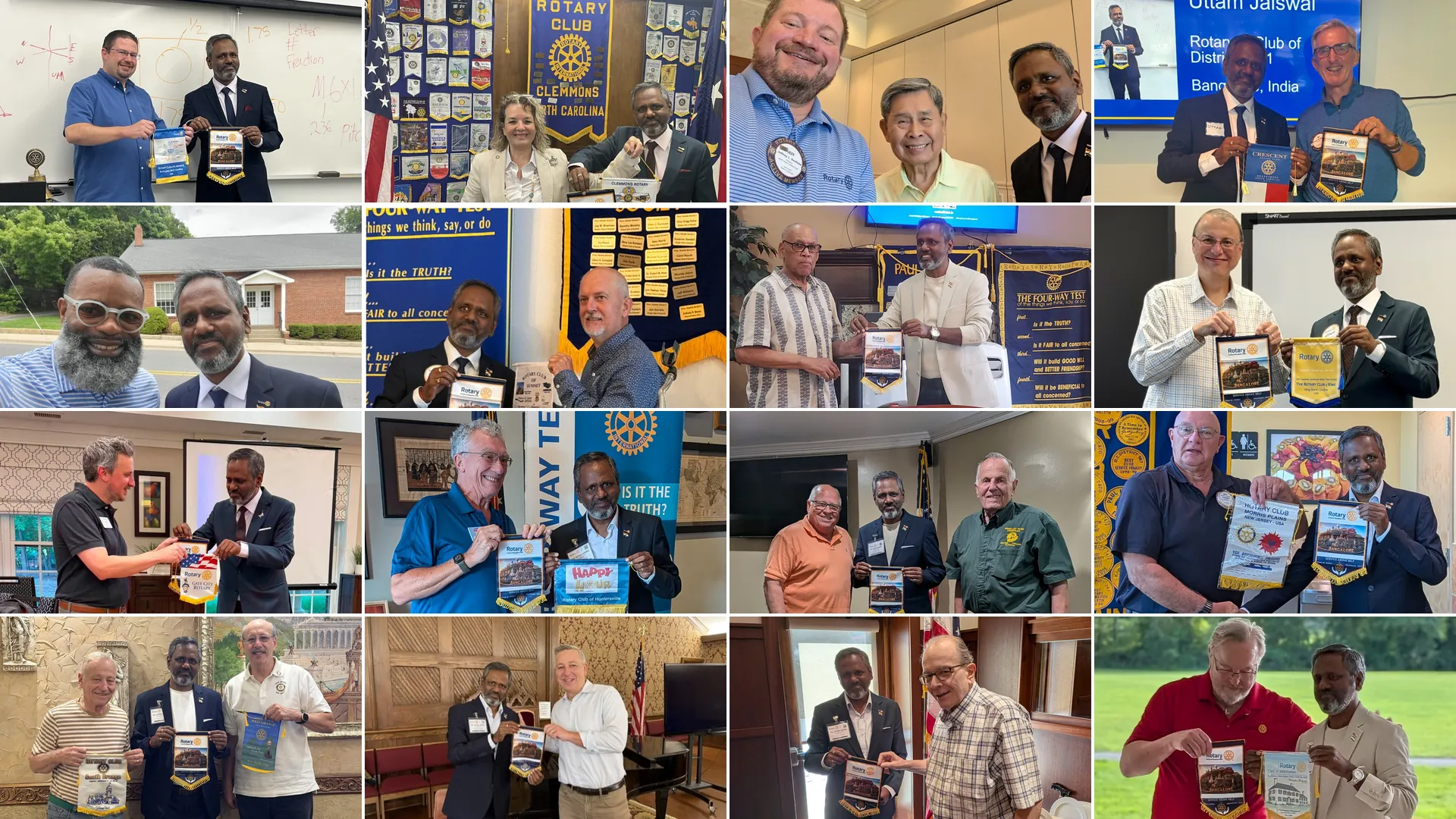
Seventeen clubs. Two states. One banner from Bangalore.
On a July afternoon in Greensboro, North Carolina, the President of the Crescent Rotary Club went looking for something his club had not used in years.
Their own club flag.
I had brought the banner of my club, the Rotary E-Club of Bangalore, to exchange, as visiting Rotarians do. He did not want me to leave with a one-way greeting. So he searched until he found Crescent’s flag, and the exchange went both ways. Then we carried on the conversation over coffee.
That small moment captures what this journey turned out to be.
Before I left India, I wrote an open letter to Rotary in America. In it, I summed up my hopes in three words: Flags. Friendships. Ideas.
Between 14 July and 26 August 2026, I visited 17 Rotary clubs across North Carolina and New Jersey, as a member of my club and in my personal capacity. This is my report back on those three words.
Flags: A Rotary Banner’s Journey Across Two States
The flag exchange is one of Rotary’s oldest traditions. A visiting Rotarian offers their club’s banner, the host club offers theirs, and each flag that hangs in a club room tells the story of a friendship made somewhere in the world.
Over six weeks, our banner travelled to seventeen clubs. Every one met differently, and every one left me with something.
North Carolina
- Alamance (14 July), where the journey began, and set the tone for everything that followed. The club met not in a restaurant but at Alamance Community College’s Applied Advanced Technology Center in Graham, a 55,000 square foot facility where young people train in welding, automotive systems, machining, mechatronics and HVAC: skills that lead straight to jobs. We exchanged flags, and the club secretary gave a Happy Dollar for their visitor from India.
- Clemmons: a 7:00 am breakfast at the Village Inn, where members arrive at 6:45 just to talk, and a classification talk celebrating 80 years of a family distribution business.
- High Point: lunch at the High Point Country Club, with no head table. The President seated me at a round table near the front, with their banner ready for the exchange.
- Crescent (Greensboro): lunch at the Greensboro Coliseum, a talk on athletes’ name, image and likeness rights, a long-lost club flag found for the exchange, and coffee afterwards.
- Salisbury: lunch at the club’s own Rotary Hut, where a future District Governor told me about the CART Fund, through which Rotarians support Alzheimer’s research.
- Summit (Greensboro): a high-energy noon meeting at Starmount Country Club. Weeks later, the club featured my visit in its August newsletter.
- Southern Guilford: an informal dinner at a kebab restaurant, where I spoke about our e-club and watched members work on a small in-house project. A club with its feet firmly on the ground.
- King: a club field trip to Forsyth Tech’s Northwest Forsyth Center, which trains future EMTs, nurses, public-safety officers and industrial technicians.
- Gate City: an early breakfast at Abbotswood at Irving Park, a talk from the local minor-league hockey team, and a President who joked that he wished he had dressed as well as his guest.
- Huntersville Happy Hour: an evening meeting in a brewery’s private room, a spirited round of Happy Dollars, and a club already running a global grant project with a Rotary club in Kerala.
New Jersey
- Maplewood: a Mexican dinner hosted by a small club with a big heart: Christmas trees, a socks drive, scholarships, sports, and Pedals for Progress, which sends bicycles and sewing machines abroad.
- Morris Plains: breakfast at 7:47 am. Not 7:45. Not 8:00. 7:47. Streamed live to members on Zoom, opening with a member’s joke and a round of good-humoured fines.
- South Orange and West Orange: two clubs at one joint lunch at Bella Italia, where West Orange welcomed me with a song.
- Summit (New Providence): Rotary songs, a talk about our e-club on the club’s screen, and, by pure coincidence, a table shared with another visiting Rotarian from India. Members were moved by our eye surgeries in West Africa, and weeks later their club posted its flag to India.
- Berkeley Heights: a small, highly motivated club that puts hands-on service first, and gave our banner a warm home.
- Morristown (26 August), the last stop: a relaxed evening cookout at Loantaka Park, with three countries under one pavilion and a Paul Harris Fellowship presented to a member.
The Morris Plains banner had its own surprise: Morse code. Samuel Morse first publicly demonstrated the electric telegraph in 1838 at Speedwell, in nearby Morristown. As someone who has spent a career in technology, I loved that a Rotary banner carried the story of one of the first technologies that connected the world.
Not every plan worked. One day in New Jersey, after a long wait, my taxi was cancelled and I could not reach the Lake Hopatcong club in time. Another visit did not work out on the day. Travel humbles you that way. I wrote to both clubs, and the door remains open.
Friendships: Welcomed Like Family
At the Southern Guilford meeting, I told the members that I had travelled nearly 14,000 kilometres to be there, and that it did not feel like that at all. It felt like coming to meet family I simply hadn’t met yet.
The clubs kept proving that true.
I was made to feel special at every single club. Not one charged me a meeting fee. As an international guest, I was simply their guest, everywhere I went.
At West Orange, I was welcomed with a song.
At Maplewood, members presented me with a customised Rotary kurta. An Indian garment, made Rotarian, gifted in New Jersey.
At Southern Guilford, a member and I exchanged pins: a Rotary Greensboro pin for my Make in India pin.
And at Morristown, the final meeting of the trip, I met the District Governor, the District Governor-Elect and Rotarians of every age. At the end of the evening, a former Mayor of Morristown kindly drove me home.
You cannot schedule moments like these. You can only show up, and let Rotary do what it has done for more than a century.
Ideas: What Travelled Between Us
The third hope in my letter was ideas. Some travelled from me to them. More travelled back.
The club on a screen
At almost every club, I introduced the Rotary E-Club of Bangalore. When I said “e-club”, eyebrows went up a little. A club that meets online? Can it do anything real?
So I told them what our members have done. Chartered in 2011, we were among India’s early e-clubs. We have screened more than 200 people at a single village health camp, vaccinated schoolgirls against HPV, and supported eye surgeries in Ghana and Nigeria that gave children back their sight.
You do not need a building to restore someone’s eyesight. You need will, a network and a plan.
Ideas they shared with me
In return, every club taught me something:
- Learning that leads to livelihoods. At Alamance, county police and sheriff departments donate their worn-out vehicles to the community college. Students learn by maintaining them, and the same cars are then used to train law enforcement cadets. The college also hires high school teachers as instructors, so students flow naturally from school into skilled trades. One simple partnership serves education, public services and employment at once. I could not stop thinking about what a similar model could do for skill-building in India.
- Happy Dollars, where members share a small contribution with a moment of good news, turning a routine meeting into a celebration.
- Classification talks, like the Clemmons member who spoke about eight decades of a family business. It is personal storytelling at its best.
- Small clubs with outsized impact. Maplewood and Berkeley Heights showed how a handful of committed members can run a remarkable range of projects.
- Hybrid meetings. Morris Plains streams its breakfast to members on Zoom: the traditional club and the e-club, meeting halfway.
- Rotary as a community anchor, from King’s field trip to a local college to Morristown’s cookout bringing together a former mayor, district leaders and families.
A living bridge
The idea I am most excited about is the simplest one.
Many of the clubs I met expressed interest in a joint online meeting with an e-club in Bangalore, so that members on two continents can meet face to face, live. For a club that already meets online, it is fellowship we are uniquely built for.
At Huntersville, I also had an encouraging conversation with their International Service Chair about whether clubs on both sides might one day explore a service project together in India.
These are conversations, not commitments. Whether and how they move forward is for the clubs themselves to decide. But every great Rotary partnership begins exactly like this: with a conversation between two people who were strangers a few minutes earlier.
What I Carried Home
I left India carrying banners. I came home carrying far more.
I came home with the flags of clubs across two American states, and with friendships that already continue over email. I also came home with a renewed belief in something Rotary has always known: when people come together in a spirit of service, geography becomes secondary.
My return to Rotary earlier this year was about coming back to values I never really left. This journey showed me how far those values can travel, and how warmly they are received on the other side of the world.
In my open letter, I wrote that if I returned with more than a collection of club flags, I would consider the journey a success.
I did.
Flags. Friendships. Ideas. All three made the journey.
And the banner’s story is not over. It now hangs in clubs across North Carolina and New Jersey, waiting for the next visiting Rotarian to ask where it came from.
Service Above Self.
With heartfelt thanks to every club, officer and member who answered my emails, welcomed a guest from across the world, and made these visits unforgettable. These are my personal reflections as a member of the Rotary E-Club of Bangalore; any future joint meetings or projects mentioned here are conversations, not club decisions.