When societies face crises, they often divide over whom to blame. But history shows that civilizations move forward not by winning arguments, but by building solutions.
Every few years, a crisis reminds us that something in our education ecosystem is broken.
A paper is leaked. A student loses hope. A family is shattered.
Public anger rises. Television debates become louder. Political narratives dominate the headlines. Protests are organized. Demands are made. Resignations are sought.
Then, gradually, we move on.
Until the next tragedy.
For a few weeks, the entire nation seems consumed by one question:
Who is responsible?
It is an important question. But perhaps it is not the most important one.
Because while we debate accountability, another question quietly waits for an answer:
How do we ensure that the next student never reaches a point where one examination feels more valuable than one life?
That is the conversation we should be having.
Every Student Suicide Is a National Failure
The causes behind student suicides are complex. Academic pressure alone does not explain every tragedy. Mental health, family circumstances, social isolation, and personal struggles all play a role. But when an education system narrows the definition of success to a single examination, it adds weight to shoulders that may already be carrying more than we know.
Whenever a young person loses hope, it represents a failure far greater than an examination. It is not merely the failure of a government, nor of an examination authority, nor of a school.
It is the collective failure of an ecosystem - parents, teachers, schools, universities, industry, communities, media, policy makers, professional bodies, and society itself.
Every student who loses hope is not merely a personal tragedy. It is a loss of human potential. A scientist who may never innovate. An entrepreneur who may never create jobs. A teacher who may never inspire. An artist who may never enrich our culture.
A nation does not merely lose a student. It loses part of its future.
If millions of young people believe that their future depends entirely upon one examination, then we have created a system that unintentionally measures success far too narrowly.
Accountability Matters. But Accountability Alone Cannot Build Hope.
A fair examination system is essential. Paper leaks must be prevented. Institutions must remain accountable. Those responsible for wrongdoing should face the consequences. Democracy demands nothing less.
But let us ask an uncomfortable question.
If every investigation is completed, if every guilty person is punished, if every political demand is fulfilled - will another student automatically discover new career opportunities? Will parents suddenly stop believing that only a handful of professions define success? Will schools begin teaching employability alongside examinations? Will employers start engaging students before graduation?
Will anxiety disappear?
Unfortunately, no.
Which means accountability, while necessary, is only the beginning. Not the destination.
The Cost of the Wrong Conversation
Every hour we spend debating only political outcomes is an hour not spent discussing what truly matters - reducing student anxiety, building career awareness, strengthening employability, creating mentoring networks, guiding parents, and enabling community participation.
Political accountability is important. But accountability should become the beginning of reform - not the end of the conversation.
If public discourse ends with identifying who should resign, while ignoring why millions of students believe they have only one path to success, then we risk solving yesterday’s crisis while leaving tomorrow’s untouched.
“The measure of a nation is not how loudly it debates its crises, but how quietly it prevents the next one.”
Are We Discussing the Right Problem?
Sometimes societies become so focused on today’s crisis that they forget tomorrow’s challenge.
The easiest conversation is: “Who should resign?” The harder conversation is: “Why are millions of students placing their entire future on a single examination?”
The easiest conversation is: “Who made the mistake?” The harder conversation is: “How do we build a system where one setback never destroys hope?”
The easiest conversation creates headlines. The harder conversation changes lives.
Construction Is Greater Than Confrontation
Every democracy naturally contains many competing voices. Some demand accountability. Some amplify public emotion. Some shape public opinion. Some seek immediate political outcomes. That is part of public life.
But students - and society - must ask a deeper question:
When today’s political conversations end, what will remain for tomorrow’s students?
A resignation cannot mentor a child. A television debate cannot expand career awareness. A slogan cannot reduce anxiety. A political victory cannot, by itself, prevent the next student suicide.
Construction can.
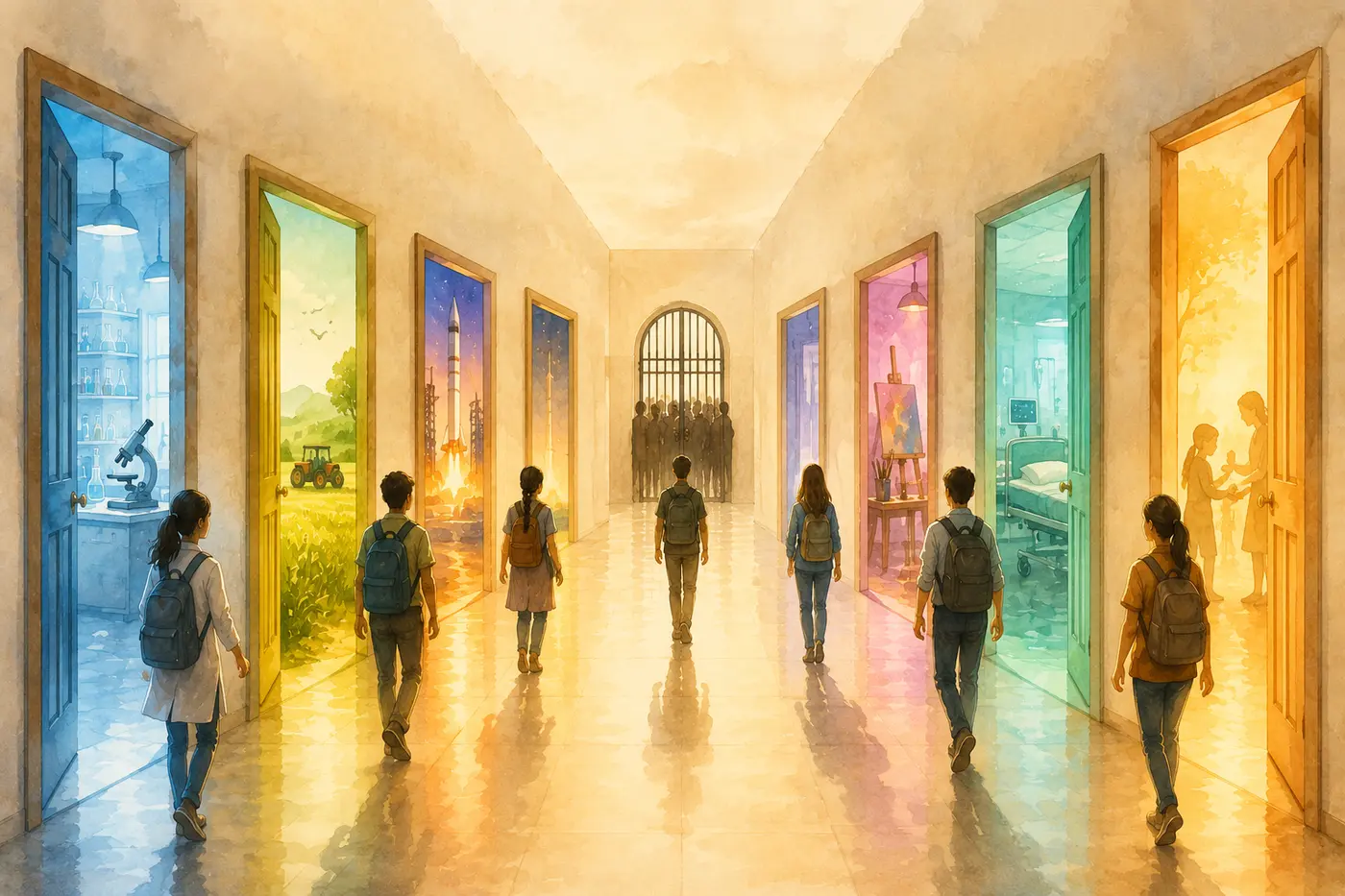
We Need More Doors, Not Just Better Locks
Whenever an examination system fails, the immediate response is to strengthen security. That is necessary.
But imagine a building with only one small exit. Millions are trying to pass through it. Even if the lock becomes perfect, the crowd remains. The pressure remains. The anxiety remains.
Perhaps the real challenge is not merely building stronger locks. Perhaps we need to build many more doors.
Doors called:
- Entrepreneurship and vocational excellence
- Research and skilled trades
- Artificial Intelligence and design
- Healthcare and agriculture
- Public service and creative professions
- Defence innovation and space technology
- Sustainability and social entrepreneurship
The future should never depend upon one examination. It should be built upon many opportunities.
Construction Is a Community Responsibility
This is one challenge that governments cannot solve alone - and one that communities are uniquely positioned to solve.
Rotary’s motto is Service Above Self. Perhaps one of the greatest services we can now offer is not another fundraiser - but another future.
Every Rotary Club has among its members doctors, engineers, entrepreneurs, teachers, scientists, lawyers, artists, and public servants. Imagine the collective impact if this knowledge were systematically shared with students before they chose their careers. Rotary already has frameworks for literacy programmes and community grants - the infrastructure exists. It simply needs redirecting toward career awareness and mentoring.
Imagine if every Rotary Club adopted five schools. Imagine if every Lions Club organized career discovery programmes. Imagine if every alumni association returned to mentor students. Imagine if every professional spent just one hour each month helping young people understand the realities of their profession. Imagine if businesses regularly opened their doors for school visits and internships.
Imagine if parents celebrated curiosity as much as marks. Imagine if success were measured not merely by admissions - but by contribution.
Millions of young people would begin to see possibilities instead of pressure. That alone could save lives.
From Protest to Participation
Peaceful protest has an honoured place in every democracy. It reminds institutions that accountability matters. But every protest should also inspire participation.
Instead of asking only, “Who should change?” - let us also ask, “What can I build?”
Can I mentor one student? Can my organisation adopt one school? Can we introduce children to professions they have never imagined? Can we create internships and apprenticeships? Can we help one family understand that success has many pathways?
Real transformation begins when citizens stop waiting for solutions and begin becoming part of them.
A Global Call for Construction
This is not an Indian problem. Across the world, the details differ - entrance examinations in one country, university admissions in another, student debt in a third, parental expectations everywhere. But the underlying fear is often the same: that one narrow pathway determines an entire future.
In every society where young people feel that a single result defines their worth, the same anxiety takes root. The languages are different. The pressure is the same.
This calls for something larger than policy. It calls for community.
Let us work together to ensure that no student’s future is defined by one examination. Let us create mentoring networks, career awareness programmes, industry partnerships, life-skills education, employability initiatives, and conversations that expand possibilities instead of narrowing them.
A Message to Every Student
Your examination is important. Your life is infinitely more important.
No rank can measure your character. No score can measure your creativity. No result can measure your contribution to humanity.
One examination measures performance on one day. It does not measure your worth for a lifetime.
Never allow anyone - whether society, social media, politics, peer pressure, or popular opinion - to convince you otherwise.
Your future is always larger than your latest result.
Let Us Build
History remembers those who fought. Civilizations remember those who built.
The choice before us is not between accountability and silence. It is between remaining trapped in cycles of outrage, or building systems that reduce the need for outrage in the first place.
Our children deserve more than better examinations. They deserve better conversations, better mentoring, better opportunities, better communities, and better hope.
Perhaps the question before us is no longer, “Who should resign?”
Perhaps the more important question is, “Who will build?”
Because our aim should never be destruction. Our aim should always be construction.
And that construction does not begin in Parliament. It begins in our homes, our schools, our workplaces, and our communities.
It begins with each one of us.
An Invitation, Not a Conclusion
This article is not a conclusion. It is an invitation.
An invitation to Rotary, Lions, educational institutions, alumni associations, NGOs, industry leaders, professionals, policy makers, parents, and teachers - to come together around one shared purpose: helping students discover that success has many pathways.
Not as a campaign. Not as an organization. But as a community that believes hope is worth building.
If you are a Rotarian, a Lion, an educator, an alumnus, a professional, or simply someone who remembers what it felt like to be young and uncertain - this invitation is for you.
One mentor. One school. One conversation. One door opened.
That is where construction begins.