Recently, I came across a situation where a well-known company made a significant investment in a large enterprise platform for their core systems.
On paper, it made perfect sense. Market leader. Proven. Feature-rich.
But stepping back, a more important question emerged:
Did they really need all of it?
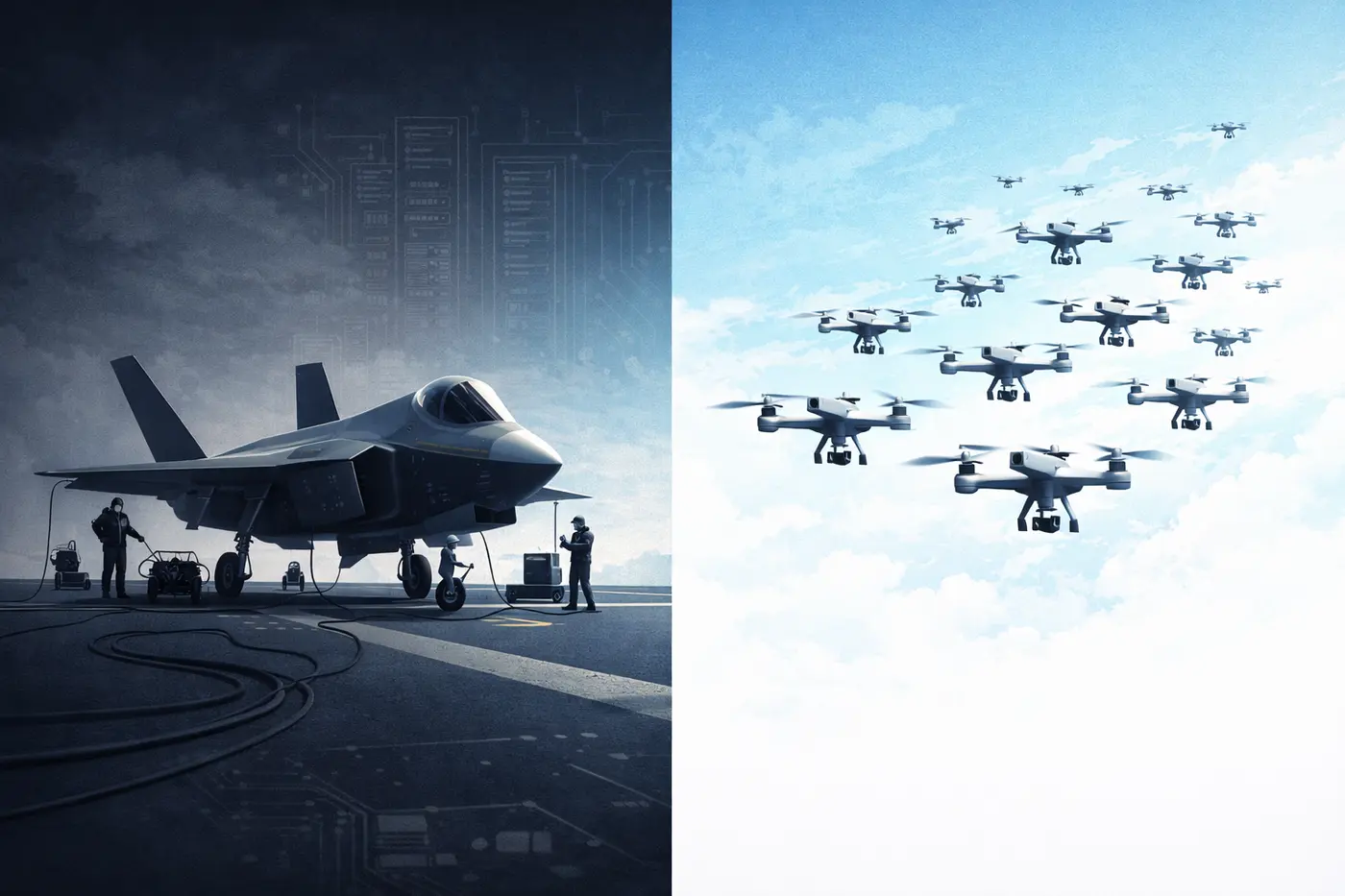
The F-35 Problem in Enterprise IT
Enterprises today are not building systems. They are buying them.
And increasingly, they are buying the F-35s of software.
- Full-scale ERP suites
- End-to-end observability platforms
- All-in-one security ecosystems
These are powerful systems, engineered for extreme scenarios.
But here’s the uncomfortable truth:
Most enterprises don’t operate in extreme scenarios.
What Modern Warfare Teaches Us
Recent conflicts have shown a shift in strategy.
High-cost, high-precision systems are being challenged by low-cost, highly scalable drones.
Not because drones are more advanced. But because they are:
- Affordable
- Replaceable
- Deployable at scale
- Good enough for the mission
The equation is changing.
It’s no longer about having the most advanced system. It’s about having the most effective and adaptable system.
The Glamour Trap
Enterprise technology decisions are often influenced by perception:
- “This is the industry standard”
- “Everyone is using this”
- “This will future-proof us”
And slowly, the decision shifts:
From:
- “Do we need this?”
To:
- “Can we afford not to have this?”
That’s where the problem begins.
If you have seen how institutional risk perception shapes technology choices, this pattern will feel familiar - the bias toward what is familiar and “accepted” over what is actually effective.
Capability vs Platform Thinking
Most enterprises are buying platforms.
But what they actually need are capabilities.
Observability is not a platform. It is logs, metrics, and traces done right.
ERP is not a monolith. It is finance, workflows, and integrations aligned to business needs.
Automation is not a product. It is programmable, repeatable processes.
When you think in platforms, you buy. When you think in capabilities, you design.
This is, at its core, the same pragmatism over fanaticism principle applied to enterprise purchasing - choosing what solves the problem over what fits the narrative.
Security Is Following the Same Pattern
This trend is even more visible in security.
Organizations are investing heavily in:
- Enterprise VPN stacks
- Full-scale Zero Trust platforms
- Complex access control systems
All in the name of security.
These systems are powerful. No doubt.
But the real question is:
Are they always necessary?
In many environments, the requirement is simple:
- Secure access to internal systems
- Controlled authentication
- Basic device and user validation
Yet the solution becomes:
- Multi-layered architectures
- Expensive licensing models
- High operational complexity
A simple problem, solved with a highly complex system.
Not Every Problem Needs an F-35
Let’s be clear.
There is a place for high-end enterprise platforms.
Highly regulated environments, massive scale, and critical infrastructure do justify them.
But not every workload needs that level of sophistication.
Not every problem needs an F-35. Most problems need a well-coordinated fleet of drones.
And in security:
Security should be proportional to risk, not proportional to budget.
The Alternative Model
A different approach is emerging.
One that focuses on:
- Composable architectures
- Open ecosystems
- Modular systems
- Automation-first operations
Instead of one large system, you build a coordinated stack of smaller, purpose-built components.
The outcome:
- Better cost control
- Higher flexibility
- Reduced dependency
- Faster adaptability
And most importantly:
You build internal capability, not just external reliance.
The Real Challenge
This is not just a technology shift.
It is a mindset shift.
Because the hardest question is not:
- “Which platform should we buy?”
It is:
- “Do we actually need this platform at all?”
A Practical Reality
In many cases, the same outcomes can be achieved with:
- Leaner architectures
- Carefully designed systems
- Open and extensible technologies
Without compromising reliability, security, or scalability.
But this requires:
- Strong architectural thinking
- Deep operational experience
- And the ability to balance enterprise constraints with modern approaches
Closing Thought
The future of enterprise IT will not be defined by who buys the most powerful platforms.
It will be defined by who can build, adapt, and scale capabilities faster.
Because in the end:
It’s not about how advanced your systems are. It’s about how effectively they serve your needs.
And sometimes, that starts with choosing drones over fighter jets.