Why domain expertise may become more, not less, important in the age of AI
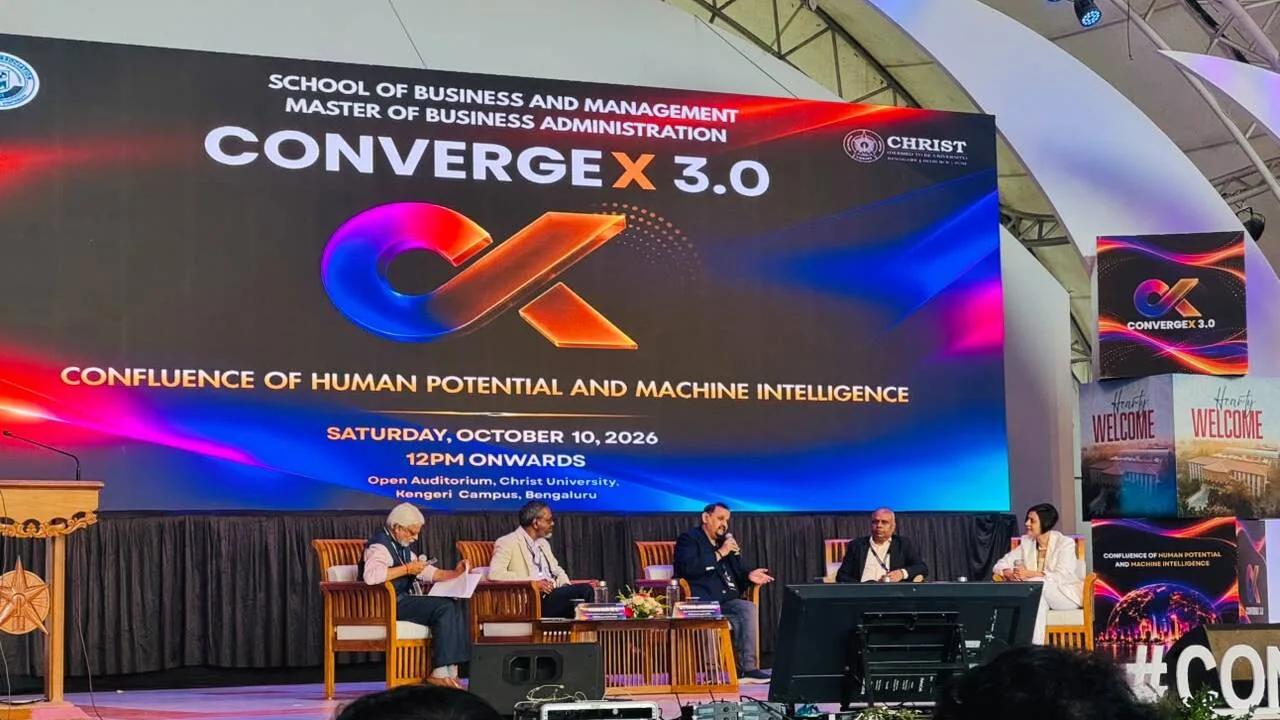
On Saturday, 10 October, I had the privilege of being part of ConvergeX 3.0 at CHRIST (Deemed to be University), Bangalore, centred around the theme “Confluence of Human Potential and Machine Intelligence.” It was a wonderful opportunity to meet faculty members and, most importantly, interact with some bright young minds.
Our panel was given a fascinating question: “Who Leads Whom? The New Human-AI Partnership.” It was a pleasure to share the stage with fellow panellists Venkatesh Ramu (Capgemini), Dr. Smrite Goudhaman (Datamatics) and Vivek Saxena (Vanexas Consulting), in a discussion moderated by Krishna Mysore Chidambareswaran of CHRIST (Deemed to be University). My thanks to the Alumni Association of the School of Business and Management for bringing us together. You can read their coverage of the panel discussion on LinkedIn.
As often happens in a good panel discussion, the time available was much shorter than the thoughts the conversation generated. One of the points I shared that afternoon came from a simple observation about how our lives have changed over the years.
We Automated Physical Work. Then We Joined Gyms.
Think about a typical household a few decades ago. We swept floors, washed clothes, climbed stairs, walked to places and performed countless small tasks by hand.
Then came machines, automation and services that made life easier. And rightly so. Why spend hours on physically demanding, repetitive work when a machine can do much of it faster and with less effort?
But something interesting happened along the way. As physical effort disappeared from our daily routines, we discovered that our bodies still needed it.
So we joined gyms.
Think about the irony. We spent generations inventing machines to reduce physical effort, and then started paying for equipment that would put some of that effort back into our lives.
There is nothing wrong with that. We didn’t throw away the washing machine because exercise is good for us. We simply separated productive physical labour from the physical exercise our bodies still need.
While sitting on that panel discussing AI, I wondered:
Are we now beginning to do something similar with our minds?
We have seen this before. GPS did not seize navigation; we delegated it, and many of us now struggle to find our way without it, even in familiar cities. We once remembered dozens of phone numbers; today most of us remember a handful. None of this is bad. But it shows something important: capabilities we stop exercising quietly weaken.
AI can write, summarise, analyse, code and research. And increasingly, AI can act.
That is tremendous progress, and we should embrace it. But just as our bodies still need exercise after machines remove physical labour, perhaps our minds will continue to need cognitive exercise even after AI removes cognitive labour.
| What machines took over | What we still need | |
|---|---|---|
| Body | Physical labour | Physical exercise |
| Mind | Cognitive labour | Cognitive exercise |
Cognitive Exercise Does Not Mean Rejecting AI
The answer is certainly not to stop using AI. We don’t wash clothes by hand just because our bodies need exercise. We use the washing machine and find better ways to exercise. Why should AI be any different?
- If AI can complete in seconds what used to take hours, let it.
- If it can automate repetitive cognitive work, use it.
- If it helps us research, analyse, write, code or troubleshoot faster, take advantage of it.
But perhaps we should reinvest some of the cognitive capacity AI gives back to us into something more valuable: learning, questioning, reasoning and building domain expertise.
There is a big difference between using AI to avoid thinking and using AI to improve our thinking.
The Same AI. Two Very Different Outcomes.
Imagine two young engineers with access to exactly the same AI.
The first has a problem and asks AI for a solution. AI produces an impressive answer. The engineer copies it, makes a few changes, checks that it works and moves on. Task completed.
The second asks the same AI the same question. But the conversation doesn’t end with the answer:
- Why did you choose this approach?
- What assumptions are you making?
- What happens if the workload increases tenfold?
- What could fail?
- What alternatives did you consider, and why did you reject them?
- Here is the approach I was considering. What is wrong with mine?
- Now argue against your own recommendation.
Both engineers used AI. Both may even have delivered the same solution. But something very different happened:
| Engineer 1 | Engineer 2 | |
|---|---|---|
| Used AI to | Complete the task | Complete the task and learn |
| After one problem | A working solution | A working solution and deeper understanding |
| Over time | Risk of greater dependence on AI | Opportunity for deeper domain understanding |
Repeat that difference over hundreds of problems and several years, and the impact could be enormous.
Domain Expertise May Become More Important, Not Less
There is an understandable assumption that as AI knows more, humans may need to know less.
I am not convinced.
Imagine two people asking the same powerful AI the same question. Someone with limited knowledge of the subject receives an impressive answer and thinks: “That sounds good.”
A domain expert reads exactly the same answer and says: “Wait.”
- You have ignored an important constraint.
- That assumption doesn’t apply in our environment.
- What happens when this architecture scales?
- You’ve missed a security consideration.
- What happens if this dependency fails?
- Your conclusion holds only if this assumption is true.
The AI hasn’t changed. The human using it has. And that changes the quality of the human-AI partnership.
I experienced this myself earlier this year. When I built an AI development system, my first attempt, a 2,000-line instruction file, collapsed into chaos. What fixed it was not a cleverer prompt. It was two decades of DevOps experience telling me that this was an orchestration problem, not a prompting problem. The AI was the same. The domain knowledge made the difference.
It works like a virtuous cycle:
- The more we understand our domain, the better questions we ask.
- The better questions we ask, the more value we extract from AI.
- The more we know, the faster we spot an answer that sounds convincing but is incomplete or wrong.
That is why I believe domain expertise may become more valuable in the age of AI, not less. AI amplifies our capabilities, but what it amplifies depends on what we bring to the partnership.
Where Will Tomorrow’s Seniors Come From?
This leads to another question I raised during the panel.
We increasingly hear that AI may automate much of the entry-level work, while experienced professionals who make higher-level decisions will remain valuable. Perhaps. But then we must ask:
If much of the junior-level work is done by AI, where will tomorrow’s senior professionals come from?
- Today’s architect was once a junior engineer.
- Today’s senior developer once struggled with code that refused to work.
- Today’s infrastructure expert once spent hours troubleshooting something that, in hindsight, had a simple explanation.
- Today’s leader once made smaller decisions, made mistakes, faced consequences and learned from them.
That struggle wasn’t merely work. It was also training.
Experience is not the number of years on a résumé. It is the accumulated learning from thousands of problems, mistakes, questions, experiments, decisions and corrections.
If a young professional uses AI mainly as a shortcut around that process, there is a risk: they may become highly productive without developing the depth of understanding that productivity appears to demonstrate.
We cannot automate away the bottom of the learning ladder and expect experts to keep appearing at the top. Universities and employers will need to rethink apprenticeship for the AI age.
So the answer cannot be to keep AI away from young professionals. Quite the opposite. Give them AI, but encourage them to use it not merely to complete their work, but to accelerate their learning.
Ask. Argue. Counter-Argue.
Consider a student who asks AI to write an assignment, submits it, and receives a good grade. Who actually became more capable? The AI did not need the MBA.
So don’t outsource your thinking simply because you can outsource your answering. One of the most important skills in using AI may have little to do with writing sophisticated prompts. It may simply be the willingness to challenge the answer.
A simple routine:
- Ask AI for an answer.
- Question it: why this approach? What assumptions did it make? What did it overlook?
- Compare: give it your own solution and ask it to find the weaknesses.
- Explore: ask for alternatives, then ask it to defend its recommendation.
- Counter-argue: ask it to argue against its own answer.
- Verify the important facts.
- Understand before you decide.
- Own it. If you cannot explain what AI produced, don’t put your name against it.
In India, we might put it a little more colourfully: Don’t become a blind bhakt of AI.
Use it extensively. Learn from it. Challenge it. Make it defend its answers. The purpose is not to prove AI wrong. The purpose is to make ourselves understand the subject better.
Make AI Your Cognitive Gym
This brings us back to the gym.
Machines reduced physical labour. We didn’t throw them away; we kept them and consciously found other ways to exercise our bodies. AI will increasingly reduce cognitive labour. We shouldn’t reject AI either. Instead, we should consciously exercise our cognitive muscles. Not only to keep learning, but because we still need enough cognitive fitness to judge the machines doing the work for us.
And here is the interesting part: AI itself can become the gym equipment.
- A teacher: explain a topic simply, then go progressively deeper.
- A critic: expose the gaps in your understanding.
- An opponent: argue against you, so you sharpen your reasoning.
- An explorer: help you learn a new subject faster and deeper.
- A challenger: question something you believe you already know.
Keep asking until you understand not merely what works, but why it works.
Don’t just use AI to finish the work. Use AI to build the expertise that makes you better at the work.
Perhaps that is one of the greatest opportunities AI offers us.
Technology Will Disrupt. We Need to Keep Evolving.
None of this means there will be no disruption. There will be. Every major technological shift has made some tasks less relevant and created new ones:
| Wave | What it changed |
|---|---|
| Industrial machines | Physical work |
| Computers | Calculation and clerical work |
| Software | Business processes |
| The internet | Access to information |
| Machine learning | Prediction |
| Generative AI | Creation and cognitive work |
| Agentic AI | Actions and entire workflows |
Some roles will disappear, many will change and new ones will emerge. The answer has rarely been to compete with machines at what they do best. It has been to move towards where human capability creates greater value:
Judgement · Context · Curiosity · Creativity · Empathy · Responsibility · Problem framing · Domain expertise
These may matter even more as execution itself becomes easier.
So, Who Leads Whom?
That brings me back to the question we were given at ConvergeX. Perhaps the answer is not about one permanently leading the other. The more interesting future is a partnership.
On the panel, I summarised that partnership as the 4 Ds:
| Who leads | What it means | |
|---|---|---|
| Define | Human | Frame the problem, the objective and the boundaries before turning to AI |
| Delegate | AI | Let AI do the work it does well: research, analysis, drafts, code, execution |
| Discuss | Human + AI | Question, argue and counter-argue until you understand the answer |
| Decide | Human | Apply judgement and context, and own the outcome |
AI leads only one of the four. The other three are where human potential lives, and they are exactly the cognitive muscles we must keep exercising: the ones that help us distinguish a convincing-sounding answer from one that actually makes sense.
The future probably will not belong to people who can work without AI. Nor will it belong to people who cannot work without AI. It will belong to people who know how to work with AI without surrendering their ability to think, learn and decide for themselves.
So use AI. Use it extensively. Let it make you more productive.
But don’t let it do the learning for you.
Make AI your cognitive gym.